

Summer Institute in Systemic Risks, Cascades and Tipping Points (CASCADE)
The Summer Institute in Systemic Risks, Cascades and Tipping Points (CASCADE) is a flagship initiative of European/Canadian institutions, focusing on meta-crisis such as climate change, pandemics, geopolitical risks, and disruptions in global supply chains of critical resources. CASCADE is organized jointly by the 新万博体育下载_万博体育app【投注官网】 of Split (Croatia), the 新万博体育下载_万博体育app【投注官网】 of Waterloo (Canada), the 新万博体育下载_万博体育app【投注官网】 of Augsburg (Germany), the 新万博体育下载_万博体育app【投注官网】 of Graz (Austria), the 新万博体育下载_万博体育app【投注官网】 of Hamburg (Germany), the Friedrich Schiller 新万博体育下载_万博体育app【投注官网】 Jena (Germany). It is initiated by the Risk-Knowledge Action Network (Risk-KAN) and carried out as an Erasmus Blended Intensive Program (BIP).
?
CASCADE aims to fill a critical gap in graduate-level and professional training in systemic risks, a concept that analyzes the accumulation of risk and tipping points through cascading impacts within and across systems and sectors. The training will focus on critical systems interdependencies and how they amplify underlying vulnerabilities, creating cascading impacts and systemic risks. Improving our understanding of the root causes of systemic risk, both biophysical and socio-economic is crucial to address contemporary challenges (some would say meta-crisis) and requires integrating different systems perspectives and fostering system thinking. Teaching will include various scientific methods such as system dynamics, material flow analysis, input-output analysis, causality models, scenario and supply chain analysis.
?
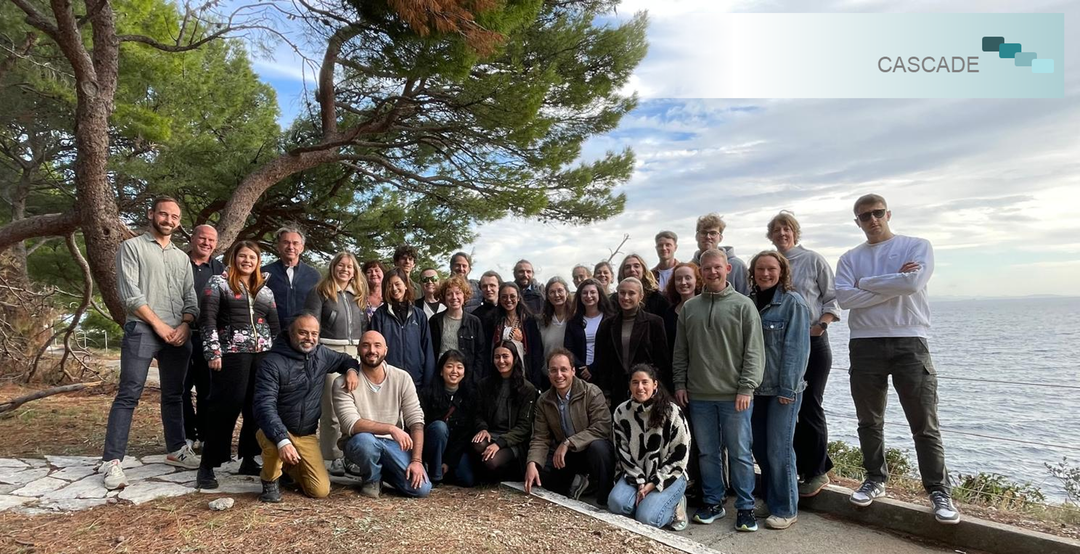
The first CASCADE Summer Institute successfully took place from October 17th to 26th, 2025, at the 新万博体育下载_万博体育app【投注官网】iterranean Institute for Life Sciences (新万博体育下载_万博体育app【投注官网】ILS) at the 新万博体育下载_万博体育app【投注官网】 of Split, Croatia. 25 Master and Ph.D. students from different European countries came together for ten days and gained foundational knowledge on key system concepts and approaches by preparatory readings, plenary sessions, and keynotes. Hands on training involved group work on different systems. The module investigating the climate and food systems examined the impact of positive narratives on sustainable food choices in the European 新万博体育下载_万博体育app【投注官网】iterranean region. The energy systems?module investigated the cascading impacts of electricity blackouts on several systems that ensure the provision of basic goods and services. This analysis was applied to two case studies: the 2021 Texas blackout and the 2025 Spain blackout. The island module examined the cascading effects of tourism on Bra?’s waste management system and how these effects might change in the future due to continued population growth. The water systems module investigated the collapse of Split's local infrastructure during the July 2025 storm event.
?
The CASCADE Summer Institute was carried out as an Erasmus Blended Intensive Program (BIP) and thereby largely funded by the European Union. The summer institute was also?part of a new international research network on Industrial Ecology between the 新万博体育下载_万博体育app【投注官网】 of Waterloo’s Climate Institute?of and the 新万博体育下载_万博体育app【投注官网】 of Augsburg - as part of Augsburg’s flagship Green Transformation. More information can be found here:?Simron Singh Launches New International Research Network on Industrial Ecology with 新万博体育下载_万博体育app【投注官网】 of A…
?
?
?
Modules of the Summer School with Tutors
?
| Module | Tutor |
|---|---|
| Climate/food system | Jana Sillmann & Franziska Gaupp |
| Critical material supply system | Ralph Aschemann & Lars Wietschel |
| Energy system | Marina Crnjac ?i?i? & Benjamin Blanz |
| Island systems | Simron Singh & Mile D?elalija |
| Water system | Jadranka Sepic & Morena Gale?i? Divi? |
?
Foundational Readings:
- Sillmann, J., & et. al. (2022).?Briefing note on systemic risk. United Nations Office for Disaster Risk Reduction (UNDRR).?https://www.undrr.org/publication/briefing-note-systemic-risk
- Klose, A. K., Wunderling, N., Winkelmann, R., & Donges, J. F. (2021). What do we mean, ‘tipping?cascade’??Environmental Research Letters,?16(12), 125011.?https://doi.org/10.1088/1748-9326/ac3955
- Renn, O., Laubichler, M., Lucas, K., Kr?ger, W., Schanze, J., Scholz, R. W., & Schweizer, P.-J. (2020). Systemic Risks from Different Perspectives.?Risk Analysis,?n/a(n/a).?https://doi.org/10.1111/risa.13657
- Otto, I. M., Donges, J. F., Cremades, R., Bhowmik, A., Hewitt, R. J., Lucht, W., Rockstr?m, J., Allerberger, F., McCaffrey, M., Doe, S. S. P., Lenferna, A., Morán, N., van Vuuren, D. P., & Schellnhuber, H. J. (2020). Social tipping dynamics for stabilizing Earth’s climate by 2050.?Proceedings of the National Academy of Sciences,?117(5), 2354–2365.?https://doi.org/10.1073/pnas.1900577117
- Binder, C. R., Athanassiadis, A., Bristow, D. N., Haberl, H., & Kennedy, C. (2025).?Tipping points towards sustainability: The role of industrial ecology.?https://doi.org/DOI: 10.1111/jiec.70000
?
Further Readings:
- Franzke, C. L. E., Ciullo, A., Gilmore, E. A., Matias, D. M., Nagabhatla, N., Orlov, A., Paterson, S. K., Scheffran, J., & Sillmann, J. (2022). Perspectives on tipping points in integrated models of the natural and human earth system: Cascading effects and telecoupling.?Environmental Research Letters.?https://doi.org/10.1088/1748-9326/ac42fd
- Schweizer, P.-J. (2021). Systemic risks – concepts and challenges for risk governance.?Journal of Risk Research,?24(1), 78–93.?https://doi.org/10.1080/13669877.2019.1687574
- Juhola, S., Filatova, T., Hochrainer-Stigler, S., Mechler, R., Scheffran, J., & Schweizer, P.-J. (2022). Social tipping points and adaptation limits in the context of systemic risk: Concepts, models and governance.?Frontiers in Climate,?4.?https://www.frontiersin.org/articles/10.3389/fclim.2022.1009234
- Armstrong McKay, D. I., Staal, A., Abrams, J. F., Winkelmann, R., Sakschewski, B., Loriani, S., Fetzer, I., Cornell, S. E., Rockstr?m, J., & Lenton, T. M. (2022). Exceeding 1.5°C global warming could trigger multiple climate tipping points. Science, 377(6611), eabn7950. https://doi.org/10.1126/science.abn7950
- 2021 David Attenborough narrated documentary?Breaking Boundaries: The Science of Our Planet. It is a nice introduction to the ideas of tipping points and the planetary boundaries introduced by?Johan Rockstr?m. It’s available on Netflix.
- IRGC GUIDELINES FOR THE GOVERNANCE OF SYSTEMIC RISKS, In systems and organisations, In the context of transitions, https://infoscience.epfl.ch/server/api/core/bitstreams/74f26a3b-a269-4afd-96e4-ec0ab6dc79a3/content
- Smith SR, Milkoreit M, Geels FW, Lenton TM. Advancing science, policy and action in tipping points research. Nat Clim Chang. Juni 2025;15(6):576–7. https://doi.org/10.1038/s41558-025-02335-9
- Kopp RE, Gilmore EA, Shwom RL, Adams H, Adler C, Oppenheimer M, u. a. ‘Tipping points’ confuse and can distract from urgent climate action. Nat Clim Chang. Januar 2025;15(1):29–36. https://doi.org/10.1038/s41558-024-02196-8
?
Lead organization:
Organizational board: